
You walk into your room, switch the fan on to full speed, and wait for relief. But minutes later, you’re still sweating, still uncomfortable, and wondering what’s wrong.
If you’re dealing with a fan not cooling room properly, you’re not alone. It’s one of the most common complaints during Pakistani summers, and the answer isn’t always “buy a new fan.” Often, it comes down to a mix of physics, room conditions, and fan technology working against you.
Let’s break down exactly why this happens, how to cool a room fast more effectively, and what you can actually do about it.
Top Reasons Your Room Stays Hot Even With the Ceiling Fan On
We’ve all faced this problem, so let’s find out the reasons behind it.
1. Your Room Has Poor Ventilation
One of the biggest reasons a room feels hot is poor ventilation.
During summer, heat can accumulate inside a closed room throughout the day. If there is no effective way for that hot air to escape, your ceiling fan simply keeps circulating the same warm air.
Imagine stirring a cup of hot tea. Moving the liquid around does not instantly make it cold. A similar principle applies to air circulation inside a poorly ventilated room.
Where practical and safe, opening windows or doors on different sides of the room may improve cross-ventilation. An appropriately installed exhaust fan may also help remove warm or humid air from certain spaces.
Practical check: If the room becomes noticeably more comfortable after improving ventilation, trapped heat may be contributing to the problem.
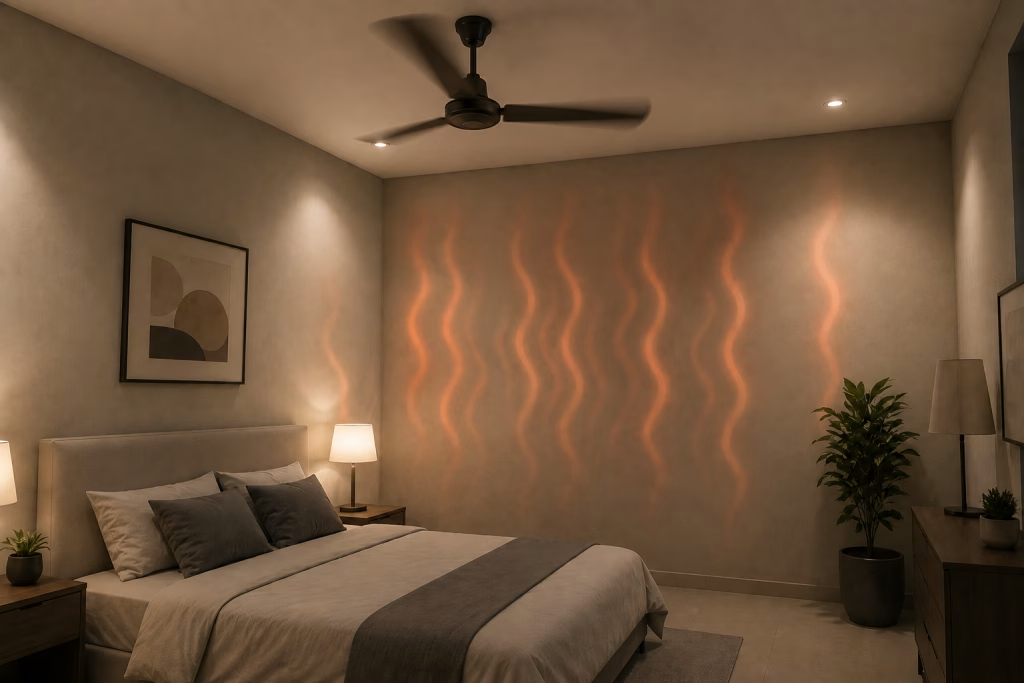
2. Your Ceiling and Walls Are Holding Heat
Rooms located directly underneath a roof can become especially uncomfortable during Pakistani summers.
Concrete roofs, exterior walls, and other building materials absorb solar heat throughout the day. That stored heat can continue radiating into the room even after the outdoor temperature begins to fall.
This explains why some top-floor rooms remain hot well into the evening.
A powerful ceiling fan can improve air movement, but it cannot completely overcome excessive heat entering through the building itself.
Roof insulation, reflective roof coatings, window shades, curtains, and reducing direct sunlight can help lower heat gain. Combined with effective ceiling-fan airflow, these measures can make the room considerably more comfortable.
3. The Fan Is Not Delivering Enough Airflow
A fan spinning quickly does not automatically mean it is delivering effective airflow.
Several factors influence air delivery, including:
- Blade design and angle
- Blade span
- Motor performance
- Installation height
- Distance between the fan and ceiling
- Room size
- Blade balance and condition
A fan that is too small for a large room may create good airflow directly underneath it but leave other areas uncomfortable.
Similarly, poorly designed or damaged blades can reduce effective air movement even when the motor appears to be running normally.
When looking for the best ceiling fan for cooling in Pakistan, don’t judge performance based on RPM alone. Effective air delivery, blade design, room coverage, motor efficiency, and appropriate fan sizing matter as well.
4. High Humidity Is Making You Feel Hotter
Temperature is only part of the comfort equation.
Humidity can make the same room temperature feel more uncomfortable because your body’s natural cooling system depends partly on sweat evaporating from your skin.
When humidity is high, evaporation becomes less effective.
A ceiling fan helps by moving air across your body and increasing evaporative cooling. However, during extremely humid conditions, airflow alone may not provide the same level of comfort you experience in drier weather.
This is why two days with similar temperatures can feel completely different.
Improving ventilation and controlling indoor humidity where possible can help your ceiling fan provide more noticeable comfort.
5. Your Fan May Be Installed at the Wrong Height
Installation can affect ceiling-fan performance.
If the blades are positioned too close to the ceiling, the fan may not have enough space above them to draw and circulate air efficiently. On the other hand, inappropriate installation for the room’s ceiling height can also reduce comfort and coverage.
The ideal setup depends on the fan model, ceiling height, room dimensions, and manufacturer recommendations.
Always follow the manufacturer’s installation specifications rather than assuming that every ceiling fan should be installed in exactly the same way.
Proper installation can make a noticeable difference without increasing electricity consumption.
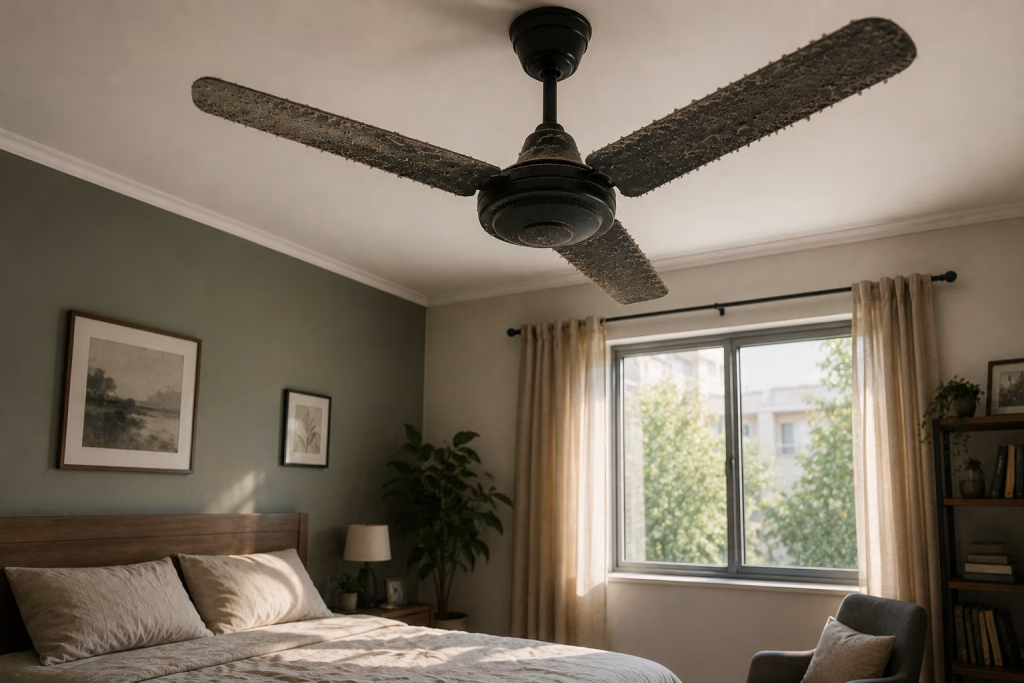
6. Dusty Blades Can Reduce Performance
When was the last time you cleaned your ceiling fan?
Dust buildup might seem like a minor issue, but layers of dirt on the blades can affect their aerodynamic performance and overall efficiency.
Over time, accumulated dust may also contribute to imbalance, vibration, and noise.
Cleaning the blades regularly helps maintain smooth airflow and allows you to check for loose fittings, damaged blades, or unusual movement.
If a fan starts making excessive noise or vibrating despite cleaning and tightening accessible fittings, it is better to have it inspected rather than ignoring the problem.
7. Heat-Producing Appliances Are Working Against Your Fan
Sometimes the ceiling fan isn’t the real problem.
Televisions, computers, gaming systems, conventional light bulbs, cooking appliances, and other electronics release heat while operating.
In a small or poorly ventilated room, several devices running simultaneously can noticeably increase the indoor heat load.
Direct sunlight through windows adds even more heat.
Try switching off unnecessary appliances, using efficient lighting, and blocking harsh afternoon sunlight with curtains or blinds.
Reducing the amount of heat entering or being generated inside the room allows your ceiling fan to provide more effective comfort.
8. Voltage Fluctuations Can Affect Conventional Fans
Voltage fluctuations are another concern in many Pakistani households.
The performance of conventional AC ceiling fans can vary when supply voltage changes. If the motor is not receiving suitable voltage, you may notice changes in fan speed and airflow.
When comparing an inverter fan vs normal fan, energy consumption is another important difference. Modern BLDC inverter fans can use substantially less electricity than many conventional AC fans while providing controlled airflow.
However, operating-voltage ranges vary between models. Before buying any low voltage ceiling fan specifically for areas with unstable voltage, check the manufacturer’s rated voltage specifications.
9. Your Old Fan May Simply Be Inefficient
Ceiling fans don’t remain new forever.
Years of continuous use, worn bearings, capacitor problems, motor deterioration, damaged blades, and poor maintenance can affect performance.
An older conventional fan may also consume considerably more electricity than a modern energy-saving ceiling fan in Pakistan while delivering less useful performance.
If your fan is unusually slow, noisy, vibrating, overheating, or requiring frequent repairs, it may be time to have it professionally inspected or to consider replacing it.
Upgrading can be particularly worthwhile in homes where fans operate for many hours every day.
What Can You Actually Do About It?
The following are some practical steps you can take to improve airflow, reduce indoor heat, and make your room feel more comfortable:
- Set your fan to counter-clockwise for summer.
- Clean blades every few weeks to maintain airflow efficiency.
- Use fans alongside ventilation, not as a sealed-room solution.
- Match fan size to room size rather than buying based on price alone.
- Reduce heat-generating appliance use during peak afternoon hours when possible.
- Choose a fan designed for stable performance during voltage fluctuations, especially in areas where voltage drops are common.
- Consider upgrading to an energy-efficient inverter or BLDC fan if your existing fan consumes too much electricity or no longer provides adequate airflow.
The best fan for hot room is ultimately one that suits the room size, provides effective air delivery, operates efficiently, and performs reliably under your household’s electricity conditions.
Why Belvin Ceiling Fans Are Built for Pakistani Summers
Belvin is known as the best fan brand in Pakistan, offering ceiling fans designed to meet the demands of Pakistan’s extreme heat, rising electricity costs, load shedding, and voltage fluctuations. Backed by over 30 years of manufacturing experience, Belvin fans combine energy-efficient BLDC technology, aerodynamic blades, and reliable build quality for effective everyday airflow.
Selected Belvin inverter fans consume approximately 30–35 watts, helping reduce electricity usage while putting less load on compatible UPS, inverter, battery, and solar systems.
Features such as Boost Mode, Sleep Mode, and remote-control operation provide greater comfort and convenience. With in-house manufacturing and quality testing, Belvin focuses on delivering efficient, reliable performance for Pakistani homes.
A Cooler Room Starts With Smarter Airflow
If your room still feels hot, fan speed may not be the only issue. Better ventilation, proper installation, reduced heat buildup, and an energy-efficient fan can make a noticeable difference.
Belvin ceiling fans combine powerful airflow with lower energy consumption for reliable everyday comfort in Pakistani homes.
For homeowners searching for the best inverter fan in Pakistan, factors such as energy efficiency, air delivery, durability, voltage compatibility, warranty, and manufacturing quality are worth considering. Belvin fans are designed around these practical requirements of Pakistani households.
Shop Belvin ceiling fans today and enjoy smarter, energy-efficient cooling.
Technical Review & Editorial Transparency
This article provides general educational information about ceiling-fan airflow, performance, and indoor comfort. Technical and installation requirements can vary by fan model, room conditions, and property. Always follow the manufacturer’s installation, operating, and safety instructions. Electrical work, wiring issues, overheating, or abnormal fan operation should be inspected by a qualified professional.